.png)
The Bowl That Refused to Be Ordinary: The Living Craft Heritage of Botswana
Updated: May 23
As an art curator, I spend my days thinking about what makes something worth looking at, worth pausing for, worth talking about. Recently, I was given these two bowls. They were made to hold things. To be functional. But the moment I unwrapped them, I knew they would never see the inside of a kitchen cupboard. They now sit on my shelves at home, catching the light, catching the eye of every person who visits.
That moment sent me down a rabbit hole I haven't quite climbed out of. I started reading, researching, and asking questions. What I found was a country with one of the richest, most deeply rooted craft cultures on the African continent and one that, frankly, doesn't get nearly enough attention in the global conversation about art. So let me change that, at least a little.
Craft as a Living Language
In Botswana, making things by hand has always been a fundamental form of cultural expression. Long before galleries and exhibitions, the Batswana people were encoding stories, beliefs, and community identity into the objects of everyday life. The craft tradition here is alive and practised daily.
The ant hill bowls that arrived at my door are a perfect example of this philosophy. Ant hill soil that is dense, sun-hardened and worked by millions of tiny engineers over years, becomes the raw material for something entirely human. The fact that it is both functional and beautiful is not incidental. In Botswana's craft tradition, those two things have never been in opposition.
The Baskets That Travel the World
Bostwana is known internationally for its basketry. Its woven baskets are widely regarded as some of the finest in Africa, carrying an international reputation that has earned them export markets across the globe.
The baskets are made using the leaf fibre of the young mokolwane palm which is stripped into strings, pounded, and soaked in boiling natural dyes to achieve their rich earth tones. Reds come from the bird plum tree, browns from the magic guarri, purples from the indigo plant. Each basket takes patience most of us can barely imagine and a large piece can take up to two weeks to complete.
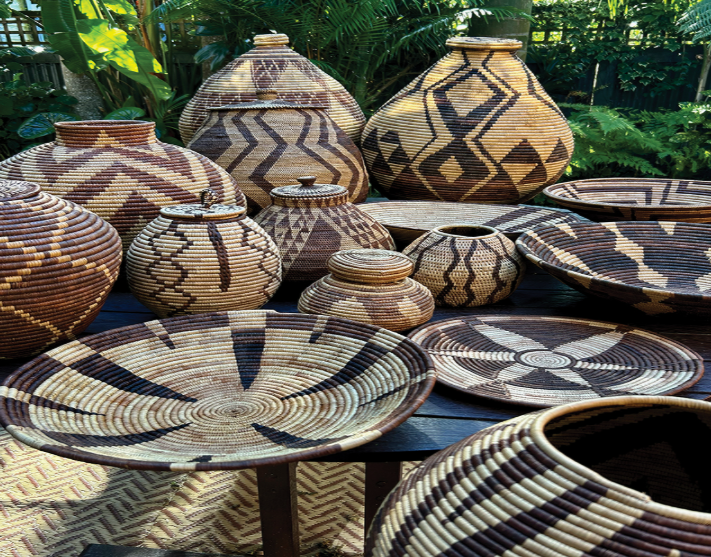
What makes them extraordinary is the storytelling. Traditional basket designs carry names drawn from the natural world: "Tears of the Giraffe," "Flight of the Swallows," "Knees of the Tortoise," "Forehead of the Zebra." Each pattern is a small poem. Each basket is a conversation between the weaver and the world around her.
Pottery: Clay from the Earth, Stories from the Fire

Historically, Batswana women in communities were responsible for collecting, moulding, and firing clay. They produced pots used for storing water, cooking, and holding traditional sorghum beer. The most prized clays were kaolin-based, producing the warm reds and browns that give Botswana ceramics their distinctive warmth.
Once shaped, vessels are decorated with patterns using natural oxides with geometric forms and animal motifs pressed into the surface before firing. Today, pottery centres in Thamaga, Gabane, Molepolole, and Gaborone are producing work that blends these ancestral techniques with contemporary forms. It is, in the truest sense, old knowledge in new hands.
A Broader Canvas: What Else Botswana Makes
Here's a quick map of the wider craft landscape because once you start looking, it is remarkably rich.
Woodcarving
Tapestry Weaving

In addition to these, there’s beadwork/jewellery and the San rock art legacy. There are also contemporary painters, sculptors, and mixed-media artists blending ancestral aesthetics with modern themes.
Why This Matters And Why Now
Here is what I keep coming back to, sitting across the room from my ant hill bowls: these objects carry time in them. The soil, the hands that shaped it, the tradition that informed those hands.
The global appetite for "authentic" and "handmade" has never been higher. And yet so much of what passes for craft is mass-produced with the veneer of authenticity. Botswana's craftspeople are the real thing and buying their work directly supports rural communities, co-operatives, and the continuation of traditions that deserve to survive.
I think about that every time I walk past those two bowls on my shelf. They were a gift. But they've given me far more than whoever handed them over probably intended; a genuine curiosity, a new lens, and a strong argument for why African craft deserves a permanent, prominent place in any serious art collection.
Start Your Collection
Authentic Botswana craft is more accessible than you think. We are working directly with local Bostwana artisans to bring an exclusive curated collection to the gallery. Be the first to know when it arrives and own a piece of this remarkable living tradition


Comments